







The Emirati Head Scarf: A Style Rooted in Place
Walk through any mall in Abu Dhabi or a majlis in Al Ain and you will notice it before you notice much else: a silk scarf wrapped close to the head, falling in a single clean line down the back or shoulder, usually in one deep, confident colour. This is the Emirati head scarf look, and it occupies its own lane within Gulf dress. It is not the same as a printed hijab tied for daily errands, nor is it identical to styles worn elsewhere in the region. It has its own proportions, its own fabric logic, and its own quiet sense of occasion.
What makes it recognisable has less to do with any single rule and more to do with restraint. The colour usually stands alone. The fabric has a controlled shine rather than a loud one. And the wrap itself sits with a kind of ease, framing the face without fuss. Women who wear this style day to day in the UAE tend to treat it less as a costume piece and more as a wardrobe habit, something reached for the same way anyone reaches for a good coat. That is really the spirit Layl is trying to bottle with this edit: pieces that read as considered rather than performative.
It is worth saying plainly that this is a living, evolving local tradition rather than a museum piece, and any store selling into it should treat it with a light hand rather than an academic one. We are not claiming to be authorities on the history of Emirati dress. We are simply trying to stock scarves that behave the way the style expects them to: good drape, good colour depth, a hem that sits flat rather than curling.
What Sets This Style Apart From Other Gulf Looks
Regional headscarf styles vary more than outsiders often assume, and the differences usually come down to three things: fabric weight, print versus solid, and how tightly the scarf sits against the head. The Emirati approach tends toward solid or very subtly patterned silk, worn with a snugger under-layer so the outer scarf can fall smoothly rather than bunch. Compare that to styles favoured in parts of the Levant, which lean toward lighter chiffon and more visible layering, or florals and busier prints that show up elsewhere in the Gulf. Neither is better. They are just different visual languages, shaped by different climates, fabrics available historically, and local taste.
If you are searching for a UAE traditional head scarf specifically, the giveaway is usually in the colour story: burgundy, bottle green, chocolate brown, black, and deep jewel tones dominate far more than pastels or busy prints. There is also a preference for a scarf long enough to wrap once around the head and still leave a clean length falling down the back, which is why length and weight matter more here than in scarf categories built around folding a square print into a smaller bandana shape.
Local Scarf Style UAE: Everyday Versus Formal
Not every Emirati scarf look is dressed up. On an ordinary weekday, the same silk or silk-blend scarf gets worn in a simpler, faster wrap, often with fewer pins and a shorter tail. For weddings, National Day events, or a formal family gathering, the wrap gets more structure: crisper pinning at the temple, a longer fall at the back, sometimes a decorative pin or brooch holding the fold in place near the ear. The fabric usually stays the same across both settings. What changes is the time spent on the wrap itself and the precision of the pinning.
Fabric and Colour: What Actually Defines the Look
Silk does most of the heavy lifting here, and not just for how it photographs. A scarf with real weight and a soft, non-slippery hand will hold a wrap shape for hours without needing constant readjustment, which matters if you are wearing it through a full day of work, prayer, or a long family event. Cheaper polyester mixes tend to slide, catch static, and lose their fold by midafternoon. That is the practical argument for spending a bit more on an Emirati silk scarf rather than treating it as a disposable accessory.
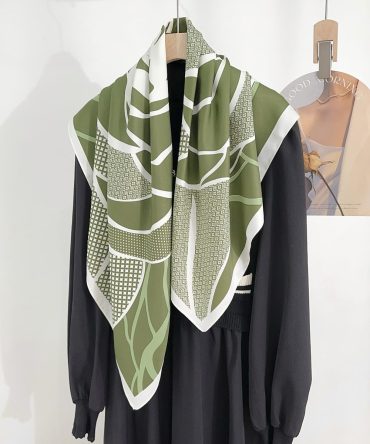
Colour is where the style really speaks. Instead of prints competing for attention, an Emirati silk scarf usually commits to one saturated shade and lets the fabric's natural sheen do the work of catching light. Deep plum, oxblood, forest green, camel, charcoal, and true black are recurring choices, occasionally lifted by a narrow tonal border or a barely-there jacquard pattern that only shows up as the fabric moves. The effect is closer to a well-made coat than a printed textile: colour first, pattern a distant second.
A note on sheen: too much shine can look synthetic under camera flash or bright mall lighting, while too little can look flat and lifeless. The scarves worth buying sit in between, a soft satin-like glow rather than a hard gloss. That balance is one of the first things worth checking with your hand before you check it with your eyes.
Emirati Silk Scarf Care Basics
Good silk rewards a little patience. Hand wash in cool water with a mild detergent, or better yet, have it dry cleaned every so often if it is worn often. Avoid wringing it, since that breaks down the fibres and dulls the shine over time. Iron on the reverse side on a low, silk-safe setting, or use a garment steamer, which is gentler and faster for scarves you wear on rotation.
Achieving the Traditional Wrap at Home
The classic Emirati wrap is more forgiving than it looks once you have done it a handful of times. Start with a well-fitted underscarf or cap so the outer silk has something to grip rather than slide against. Drape the scarf so one side is noticeably longer than the other, then bring the shorter side across the front and pin it just above the ear, keeping the fabric smooth rather than gathered. The longer side wraps around and either tucks under at the opposite ear or is left to fall down the back, depending on how formal the occasion is.
A few things make the difference between a wrap that looks intentional and one that looks like it is fighting you. First, iron or steam the scarf before wearing it; creases show up far more on solid silk than they do on a busy print, since there is nothing else to distract the eye. Second, use small, flat pins rather than bulky clips, positioned so they disappear into the fold rather than sitting on top of it. Third, resist the urge to pull the fabric too tight across the forehead. The style looks best with a bit of softness at the crown rather than a stretched, flattened line.
Practising the fold on a day with nowhere to be is worth it. Most people find their own shortcut within a week or two, whether that means pre-pinning one side the night before or keeping a dedicated set of small pins in a bag just for this purpose.
Getting the Fall Right at the Back
Length matters more than most people expect. A scarf that is too short will look pinched and rushed no matter how well it is pinned, while the right length gives you a long, calm drop down the back that moves naturally when you walk. If you are unsure of sizing, err on the side of slightly longer rather than shorter, since excess length is easy to fold away but a short scarf cannot be stretched.
When This Style Gets Worn
National Day is probably the moment this look is most visible en masse, when streets and offices across the UAE fill with scarves chosen deliberately in flag-adjacent tones or classic solids as a mark of pride. Weddings are another obvious occasion, where the wrap tends to get its most formal treatment, often paired with a matching or complementary abaya and finished with a decorative pin. Family gatherings, whether a Friday lunch or an Eid visit, sit somewhere in the middle: dressed enough to show effort, relaxed enough not to need a mirror check every ten minutes.
Then there is the everyday version, which is arguably where the style earns its keep. A well-chosen Emirati hijab style scarf in a versatile shade like camel, navy, or black works across a school run, an office day, or a coffee catch-up without ever feeling like it was put on for a special event. That range, from a quick weekday wrap to a wedding-ready fold, is part of why this category has stayed a wardrobe staple rather than a once-a-year purchase.
Plenty of shoppers looking for an Emirati scarf Dubai retailers stock are actually buying for exactly this reason: not a single occasion, but a rotation of two or three colours they can reach for regardless of what the week holds.
Shopping the Layl Edit
Every scarf in this collection is chosen with the traditional Emirati wrap in mind: enough length to fall properly at the back, a weight that holds a fold without fighting you, and a colour palette built around the solid, rich tones the style is known for rather than busy prints borrowed from other categories. Prices sit across a range in AED depending on fabric weight and finish, and orders over AED 200 ship free anywhere in the UAE, with delivery typically landing within one to three business days across Dubai, Abu Dhabi, Sharjah, and beyond. Cash on delivery is available for anyone who prefers to pay at the door, and Apple Pay makes checkout quick for a same-day order. If you would rather spread the cost, Tabby and Tamara let you split payment into instalments at checkout without any extra steps.
Frequently Asked Questions
What fabric is best for an Emirati head scarf?
Silk or a high-quality silk blend is the standard choice. It holds a wrap shape through a long day, resists static, and carries colour with a depth that thinner or synthetic fabrics simply cannot match. If you are new to the style, starting with a mid-weight silk rather than the lightest option available will make the wrap easier to manage while you get used to the fold.
How is an Emirati head scarf different from a regular hijab?
The main differences are fabric, colour, and wrap style. A regular hijab, in the broader sense used across many countries, comes in endless fabrics, prints, and shapes. The Emirati style narrows that down to solid or subtly patterned silk, worn in a specific fold that sits close at the crown and falls in a clean line at the back, often over a fitted underscarf.
What colours are traditional for this style?
Deep, saturated solids dominate: black, chocolate brown, burgundy, bottle green, camel, and navy are among the most common. Bright prints and busy patterns are less typical here than in other scarf categories, since the look leans on colour depth and fabric sheen rather than pattern to make an impression.
Do you deliver Emirati head scarves across the UAE?
Yes. Layl delivers to Dubai, Abu Dhabi, Sharjah, and the wider UAE within one to three business days. Orders over AED 200 qualify for free shipping, and you can pay by cash on delivery, Apple Pay, or split the cost with Tabby or Tamara at checkout.